In the world of diesel generators, where raw power meets operational reliability, one critical decision often determines the success or failure of an installation: the choice of cooling system. This decision transcends mere technical preference; it dictates where a generator can be deployed, how much power it can reliably produce, how often it needs maintenance, and even its total cost of ownership over a decade of service. For engineers, procurement specialists, and facility managers, understanding the fundamental differences between air-cooled and water-cooled systems is not optional—it is the cornerstone of intelligent power planning.
As engine technology has advanced, the divergence between these two cooling philosophies has become more pronounced. One offers simplicity and environmental ruggedness; the other delivers unmatched thermal efficiency and power density. This comprehensive guide explores both technologies in depth, providing the insights necessary to make an informed selection for your specific application.
The Fundamentals: How They Work
Before comparing performance, it is essential to understand the underlying physics of each system.
Air-Cooled Technology: Simplicity in Motion
Air-cooled generators operate on a principle as old as internal combustion itself: direct heat exchange with the atmosphere. The engine is designed with extensive finning on the cylinders and cylinder heads—dramatically increasing the surface area exposed to air. A powerful fan, often directly driven by the engine, forces high-velocity air across these fins, carrying away heat through convection.
This system is a closed loop of air, requiring no intermediate fluid. It is most commonly found on single and twin-cylinder engines, powering small to medium generator sets typically under 50-80 kW. The design is minimalist: no water pump, no radiator, no hoses, and no thermostat controlling fluid flow. This mechanical purity is both its greatest strength and its fundamental limitation.
Water-Cooled Technology: Engineered Thermal Management
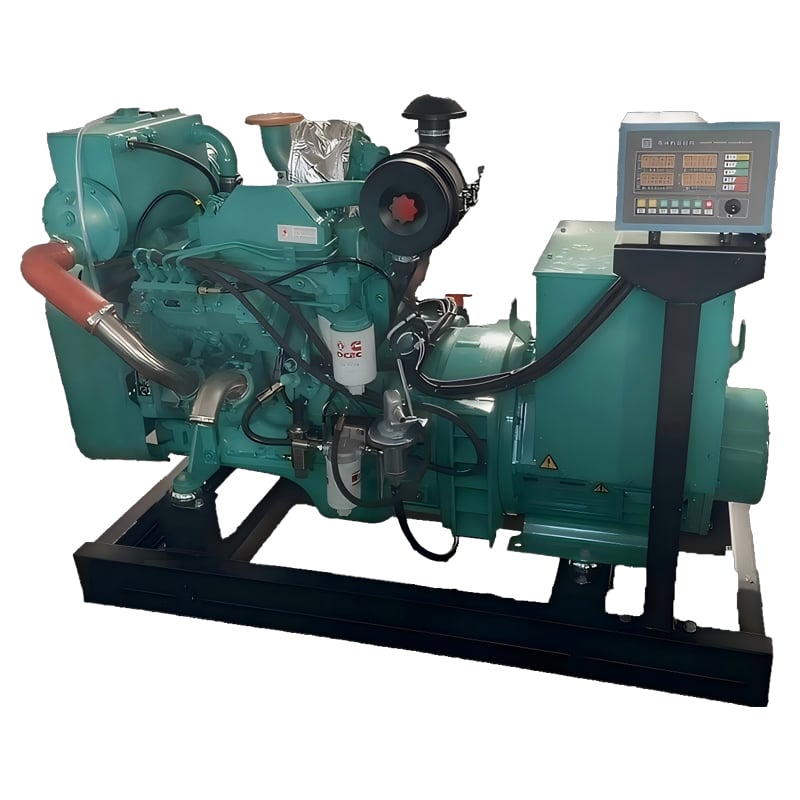
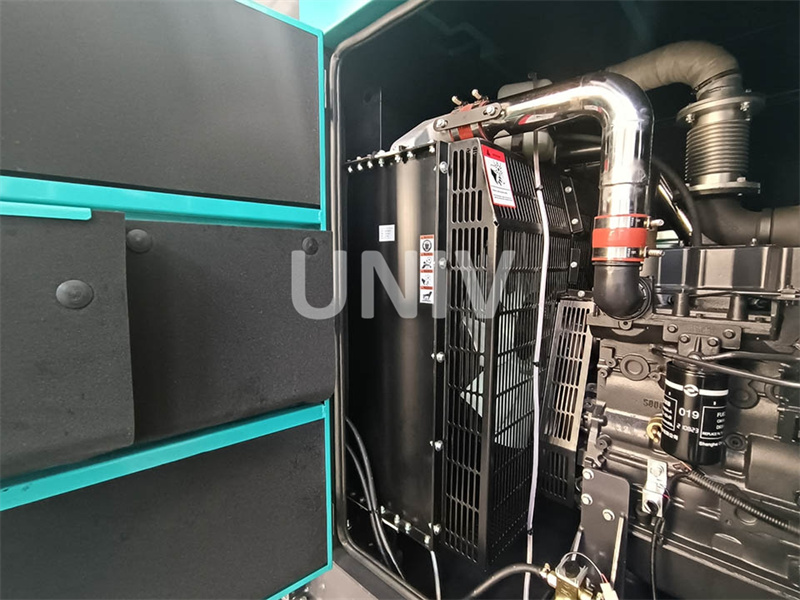
Water-cooled systems employ a secondary fluid loop to transport heat. A mixture of water, antifreeze, and corrosion inhibitors is pumped through internal passages cast into the engine block and cylinder head. This coolant absorbs heat directly from the metal surfaces and is then circulated to a radiator, where a fan—either engine-driven or electrically powered—dissipates the heat to the atmosphere before the cooled fluid returns to the engine.
This closed-loop liquid system is far more complex, incorporating a centrifugal pump, a thermostat to regulate flow, expansion tanks, and a network of hoses and clamps. It is the standard for virtually all multi-cylinder engines—from four-cylinder industrial diesels to massive V12 and V16 power units generating megawatts of power.
Performance Under Diverse Conditions
The choice between these two technologies becomes clear when examining their behavior in real-world operating environments.
Thermal Efficiency and Power Density
Water is an exceptional heat transfer medium. Its specific heat capacity and thermal conductivity far exceed that of air. This fundamental property allows water-cooled engines to maintain much more uniform temperatures across all cylinders, even under heavy, sustained loads. The result is that for a given engine displacement, a water-cooled design can produce significantly more power while maintaining safe operating temperatures. This higher power density—more kilowatts per kilogram of engine weight—is why all large, high-output generators are exclusively water-cooled.
Air-cooled engines, by contrast, face inherent thermal challenges. The cooling effect is dependent on ambient air temperature and the volume of air the fan can move. Cylinders located in less-direct airflow paths can run hotter than others, leading to thermal imbalance. This limits the practical power output and makes air-cooled designs less suitable for continuous, high-load operation in hot climates.
Environmental Adaptability: The Air-Cooled Advantage
However, air-cooled systems possess a decisive advantage in extreme environments. Because they require no liquid, they are immune to the three great killers of water-cooled systems: freezing, boiling, and corrosion.
Cold Weather Operations
In Arctic conditions, a water-cooled generator requires careful management of antifreeze concentrations. If the mixture is wrong or if the generator is shut down without adequate protection, freezing coolant can crack the engine block—a catastrophic and expensive failure. An air-cooled generator can be started at -40°C without a second thought, as there is nothing to freeze.
High Altitude Performance
At elevations above 1,500 meters, the boiling point of water decreases. This means water-cooled generators operating on plateaus or in mountainous regions require power derating to prevent coolant boil-over. Air-cooled units, while also suffering some power loss due to thinner air, face no such cooling system crisis.
Water-Scarce Regions
In deserts or remote areas where distilled water and premixed coolant are difficult to procure, the air-cooled generator's independence from liquid coolant is a massive logistical advantage.
Acoustics and Installation
The noise profile of the two systems differs markedly. Air-cooled generators typically require installation in open or well-ventilated compartments because the cooling air must flow freely across the engine fins. This direct exposure means engine mechanical noise is radiated with little attenuation, making these units inherently louder.
Water-cooled generators, particularly large ones, offer superior acoustic control. Because the primary heat exchanger (the radiator) can be remotely mounted, the engine itself can be enclosed in a heavily soundproofed canopy or even a separate room. The only noise escaping is the relatively quiet whoosh of the radiator fan. This makes water-cooled units the only practical choice for noise-sensitive environments like hospitals, hotels, and residential backup installations.
Maintenance: Simplicity vs. Complexity
The maintenance burden of each system aligns with its mechanical complexity.
Air-Cooled Maintenance
focuses on keeping cooling fins clean and ensuring fan belt tension is correct. Debris like grass, dust, and chaff can pack into the fins, insulating the engine and causing rapid overheating. Regular cleaning with compressed air is essential. However, there are no coolant changes, no water pump seals to fail, and no risk of internal coolant leaks contaminating the oil.
Water-Cooled Maintenance
involves a broader scope. Coolant must be periodically tested and replaced to maintain its anti-corrosion and freeze protection properties. Hoses degrade over time and can burst under pressure. Water pump seals eventually leak. The radiator core can become clogged externally with debris or internally with scale. However, when properly maintained, the system provides stable, predictable cooling regardless of ambient conditions.
Cost Considerations: First Cost vs. Lifecycle Cost
The initial purchase price of an air-cooled generator is generally lower. The design is simpler, with fewer components and less manufacturing complexity. For intermittent use, small power requirements, or applications in harsh environments where water-cooling would be problematic, the air-cooled unit often represents the most economical choice.
However, for continuous duty, high-power applications, the water-cooled generator's superior thermal management translates directly into longer engine life and better fuel efficiency. The ability to maintain precise operating temperatures reduces wear, minimizes carbon buildup, and optimizes combustion. Over a 20,000-hour operating life, these factors can offset the higher initial investment many times over.
Making the Selection: A Decision Framework
Choosing between air-cooled and water-cooled technology should be guided by a clear assessment of operating parameters:
· Power Requirement: If your need exceeds 100 kW, the decision is already made—water-cooled is the only viable option. For smaller loads, both remain in consideration.
· Environmental Conditions: Will the generator operate in extreme cold, at high altitude, or in remote areas with limited logistical support? If yes, the rugged independence of air-cooling is compelling.
· Noise Constraints: Is the installation near residential areas, hospitals, or offices? If quiet operation is mandatory, water-cooled with remote radiator mounting is likely required.
· Duty Cycle: Is this for occasional standby use or continuous prime power? Continuous, high-load operation favors the superior thermal stability of water-cooling.
· Maintenance Capability: Does your team have the expertise to manage cooling system chemistry and component replacement, or is the simplicity of "just keep it clean" more aligned with your capabilities?
Conclusion: Two Technologies, One Goal
Both air-cooled and water-cooled diesel generators have earned their place in the power generation landscape through decades of proven service. The air-cooled generator is the rugged individualist—simple, tough, and indifferent to the elements. It thrives where conditions are harsh and support is minimal. The water-cooled generator is the sophisticated workhorse—complex, powerful, and capable of sustained high performance in controlled environments.
There is no universally "better" system; there is only the system better suited to your specific application. By understanding the physics, the economics, and the operational realities of each, you can select a generator that will not just run, but will thrive, delivering reliable power for years to come. The key lies in matching the technology to the mission, ensuring that when the grid fails or the project demands power, your cooling system is an asset, not a liability.
If you are interested in the backup diesel generator set, please contact us.
Media Contact:
Name:William
Email: [email protected]
Phone: +86 13587658958
Whatsapp: +86 13587658958
 Hot News
2026-08-14
2026-07-17
2026-07-08
2026-06-03
2026-05-26
2026-04-16
Welcome to UNIV POWER, Our products offer ODM and OEM services, including power generation set, lighting towers and air compressors, etc.
No. 18-9 Nanshan Road, Qujiang District, Quzhou City, Zhejiang Province
Copyright © Zhejiang Universal Trading Co.,Ltd. All Rights Reserved Privacy Policy Blog
 EN
EN